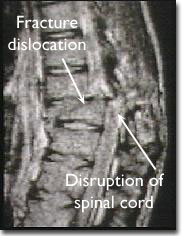
- Squeezing or shearing
of the spinal cord results in destruction of gray and white matter and a variable
amount of hemorrhage (traumatic necrosis of the spinal cord tissue)
- Changes are maximal
at the level of injury and one to two segments above and below it
- Complete transections
of the spinal cord (below) are rare and result in a complete loss of sensory
and motor function below the lesion. A state of spinal shock develops in which
all reflex functions in the isolated part of the cord are completely suspended.
In most cases, the reflexes return after several weeks and become highly exaggerated.