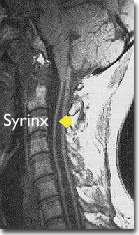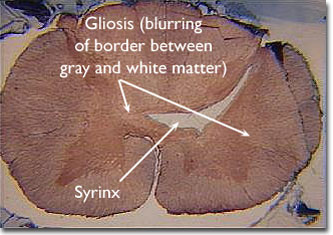
- Syringomyelia describes
an intramedullary cavitation (syrinx) of the spinal cord (MRI below, left)
causing destruction of fibers and gray matter (below, right)
- Syringobulbia denotes
a cavitation in the brainstem
- Symptoms depend on the
location of the lesion (most often lower cervical cord) and the extent of
involvement. There is wasting weakness and sensory loss at the level of the
syrinx. Dissociated sensory loss is a classical finding, i.e. impairment of
pain and temperature sensations due to interruption of decussating spinothalamic
fibers by the cyst accompanied by relative preservation of fine touch, vibration
and position sense due to sparing of dorsal columns
- In advanced disease,
extension of the lesion into the anterior horns with loss of motor neurons
causes amyotrophy which begins in the small muscles of the hand, ascends to
the foreram and finally to the shoulder girdle
- Involvement of the ascending
and descending neighbouring tracts occurs as the syrinx evolves