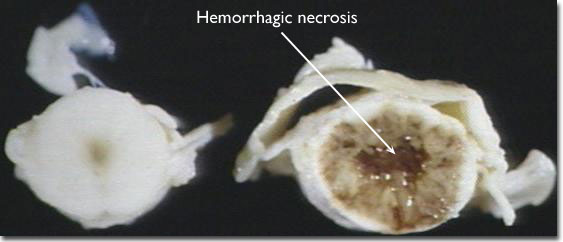
- Spinal cord hemorrhage
is rare when compared to cerebral hemorrhage and usually arises from trauma
(ex. acceleration/deceleration injury), vascular malformations or bleeding
disorders (particularly due to administration of anticoagulants)
- Hemorrhage can result
in ischemia of the involved segment leading to necrosis (below); clinical
signs and symptoms of an intramedullary hemorrhage include sudden, severe,
localized back pain with or without radicular pain, hemi-, para- or quadriparesis,
sensory loss below the lesion
- Extension of the lesion
can lead to subarachnoid or subdural or epidural hemorrhage. The latter two
cause compressive symptoms due to presence of hematomas in subdural or epidural
space.