

|
|
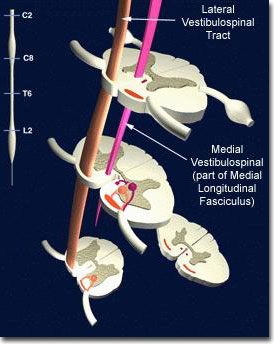
There are 2 pathways through which the vestibular system influences motor activities, the lateral vestibulospinal tract and the medial vestibulospinal tract.
The fibers of the lateral vestibulospinal tract originate in the lateral vestibular nucleus in the brainstem (pons). This nucleus derives most of its input from the cerebellum. The fibers descend ipsilaterally within the anterior part of the white matter of the spinal cord. The other vestibular nuclei give descending fibers that are called the medial vestibulospinal tract and contribute to a pathway called the medial longitudinal fasciculus, otherwise known as the MLF.
Functionally, the lateral vestibulospinal tract is mainly involved in the postural adjustments of the body to the influences of gravity, as we move about. The MLF component is part of a system that coordinates vestibular influences with movements of the eyes and movements of the head and neck.